Paytm is an Indian multinational technology company specializing in Paytm company full explain detailand financial services. It was founded in 2010 by Vijay Shekhar Sharma and is headquartered in Noida, India. It started as a mobile recharge platform and has since grown into a financial services behemoth.
Paytm company full explain detail
Paytm (an acronym for “Pay Through Mobile”) is an Indian digital payments and financial services platform established under the parent company One97 Communications Limited, which was founded on December 2000 by Vijay Shekhar Sharma. Paytm itself was launched as a prepaid mobile and DTH recharge platform in 2009 before pivoting to become a comprehensive digital payments ecosystem in 2010
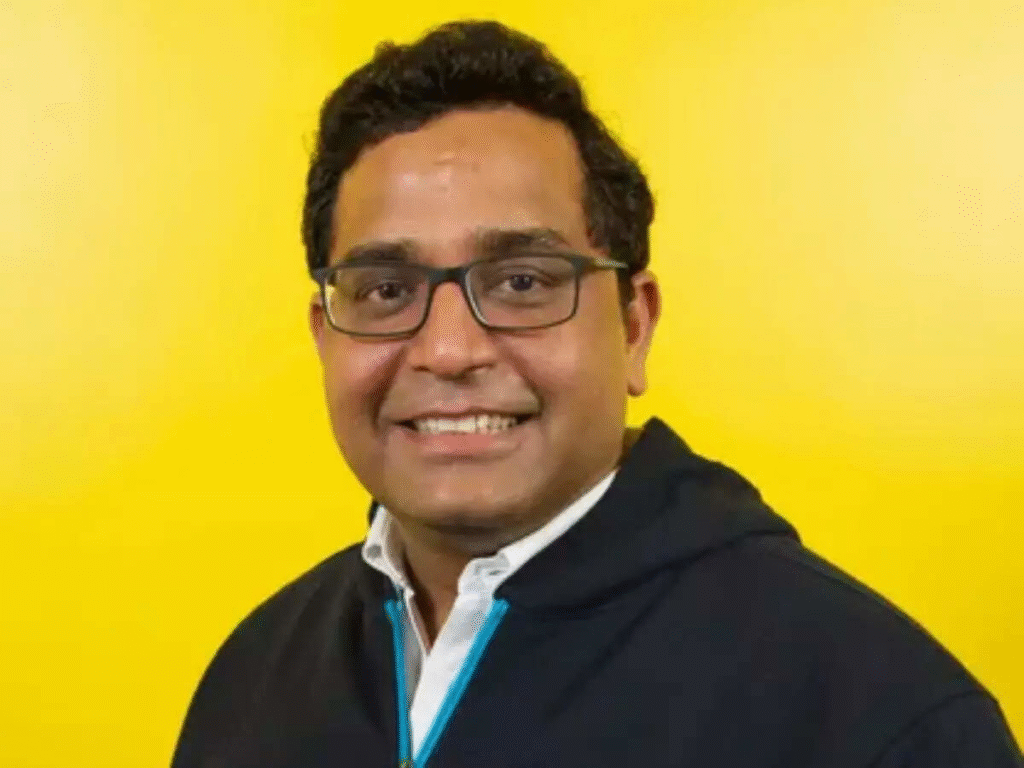
Portrait of Vijay Shekhar Sharma, founder and CEO of Paytm, against a bright yellow background
Vijay Shekhar Sharma, born on June 7, 1978, in Aligarh, Uttar Pradesh, demonstrates an exceptional entrepreneurial trajectory. He enrolled in college at just 15 years old and graduated with a Bachelor of Engineering (B.Tech) in Electronics and Communications from Delhi College of Engineering at 19. Before founding Paytm, Sharma created indiasite.net during his college years and sold it for $1 million at age 21. In 1997, he co-founded XS Communications, a content management company, while still a student. His achievements earned him recognition as one of Time Magazine’s 100 Most Influential People in 2017 and a position on Forbes’ Billionaires list as of September 2022.
Organizational Structure and Ownership
One97 Communications Limited operates as the holding company for Paytm and its subsidiaries, managing a diversified portfolio of financial and payment services. As of 2025, the ownership structure reflects a blend of founder control and institutional investment.
Shareholding Pattern
Paytm company full explain detail
According to recent data, the major shareholders include:
- Vijay Shekhar Sharma (founder and CEO): 19.42% stake, though he recently stepped down from his role as part-time non-executive chairman of Paytm Payments Bank in 2024 due to regulatory challenges
- Ant Financial Services Group (Alibaba affiliate): 9.89% stake, reflecting Alibaba’s strategic interest in Indian fintech
- SoftBank Group Corporation: Significant institutional investor with majority influence in partnership with Walmart
- SAIF Partners: 15.41% venture capital stake
- Public Shareholders: 17.60% retail investor base post-IPO
In October 2025, One97 Communications completed the acquisition of the remaining 51% stakes in Paytm Intelligence Limited and Paytm Life Insurance Limited from founder Vijay Shekhar Sharma and VSS Holdings Private Limited, making both entities wholly-owned subsidiaries.
IPO and Public Listing Milestone
Paytm executed India’s largest initial public offering (IPO) in November 2021, raising $2.5 billion at a valuation of $19 billion. The company listed on November 8, 2021 on Indian stock exchanges (NSE and BSE), marking a watershed moment in India’s fintech sector.
However, the IPO was accompanied by significant regulatory scrutiny. In February 2024, SEBI issued show cause notices to Paytm and founder Vijay Shekhar Sharma regarding potential non-compliances with SEBI regulations regarding promoter classification and eligibility to receive Employee Stock Option Plans (ESOPs). The matter was subsequently settled, with Paytm cancelling ESOPs granted to Sharma, and he was barred from accepting fresh ESOPs from any listed company for three years.
Current Stock Performance
As of November 2025, Paytm’s share price stands at approximately ₹1,268, representing a 52% decline over the past 12 months from ₹2,560. The stock has demonstrated significant volatility, trading between ₹481.65 and ₹1,128.50 over the 52-week period. The company’s market capitalization is approximately ₹67,000-70,000 crore (roughly $8-8.5 billion), marking a substantial correction from its post-IPO valuation. Analyst recommendations remain mixed, with 50% buy ratings, 31% hold ratings, and 19% sell ratings among experts.
Core Business Segments
Paytm operates across multiple interconnected business verticals that create a comprehensive financial and commerce ecosystem.
1. Paytm Digital Payments and UPI
Paytm’s foundational business segment facilitates digital payments through multiple channels. The platform enables peer-to-peer (P2P) transfers via UPI, wallet-based transactions, card payments, and QR code-based merchant payments. Users can perform mobile recharges, bill payments for utilities, loan EMI payments, and insurance premium payments through the integrated app.
As a Third-Party Application Provider (TPAP) in the UPI ecosystem, Paytm operates through partner banks including Yes Bank, Axis Bank, and ICICI Bank, adhering to NPCI’s (National Payments Corporation of India) regulations. The company processes approximately 1.39-1.5 billion UPI transactions monthly as of September-October 2025, representing roughly 7% of India’s total UPI market share, positioning it third after PhonePe (46% share) and Google Pay (35% share).
2. Merchant Payment Solutions
Paytm’s merchant segment represents a significant revenue driver with 1.24 crore (12.4 million) device merchants as of March 2025, reflecting a 63% CAGR and 4.3x growth since March 2022. The company deploys multiple acceptance technologies:
Soundbox Devices: Paytm’s iconic audio-alert payment terminal that announces every transaction. The company has innovated to launch Card Soundbox, a unified device combining QR code scanning with NFC-based card payment acceptance (up to ₹5,000 per tap) through Visa, Mastercard, American Express, and RuPay networks. These made-in-India devices feature 4G connectivity, 4W speakers for payment alerts in 11 languages, and five-day battery life.
Payment Gateway and QR Solutions: Paytm offers comprehensive payment gateway services for online merchants and QR code solutions for in-store acceptance. The QR code scanner’s presence across urban and rural areas—from malls to vegetable vendors—has driven cashless transaction adoption.
Subscription-Based Model: The merchant acquiring business monetizes through device subscriptions (Soundbox/POS rentals), Merchant Discount Rate (MDR) commissions on card and select UPI transactions, and gateway fees for online payments.
As of FY25, the device merchant base reached 1.24 crore merchants with significant progress in redeploying devices from inactive to new merchants. The merchant loan distribution business expanded substantially, growing from ₹1,386 crore in FY 2021-22 to ₹13,958 crore in FY 2024-25, a 10x expansion.
3. Financial Services Distribution
This high-margin segment represents Paytm’s fastest-growing business line, with revenue reaching ₹545 crore in Q4 FY25 (9% quarter-over-quarter growth).
Insurance Distribution: Paytm partners with leading insurers to distribute health, life, motor vehicle, travel, and property insurance policies directly through its app. SBI General Insurance was among the first insurers to launch premium payment facilities on the platform.
Wealth Management via Paytm Money: The platform offers equity stock trading, IPO investments, futures & options (F&O), bonds, and mutual funds through the Paytm Money app. The wealth platform provides features including direct mutual fund plans (avoiding distributor markups), seamless SIP (Systematic Investment Plan) automation through UPI Autopay, instant redemption facilities for liquid mutual funds (allowing withdrawal of up to 90% or ₹50,000, whichever is lower within 30 minutes), and zero investment charges.
Personal and Business Loans: Paytm facilitates unsecured personal loans up to ₹10 lakhs with flexible 36-month repayment terms, business loans for registered enterprises, and loan against property offerings.
Merchant Loan Distribution: The company expanded lending to merchants, with average ticket sizes increasing 1.5x to ₹2.1 lakh, demonstrating market appetite for SME credit.
4. E-Commerce – Paytm Mall
Launched in 2017, Paytm Mall emerged as a unique hybrid e-commerce platform designed to digitize offline retail rather than replace it. The platform achieved unicorn status ($1.9 billion valuation) within one year, backed by SoftBank’s $400 million investment and Alibaba’s $45 million in April 2018.
The platform’s hybrid retail model integrates local shopkeepers with digital infrastructure, offering consumers electronics, fashion, groceries, and home essentials. By enabling QR-code-based commerce from neighborhood stores, Paytm Mall created a unique position between pure online and offline retail. However, in August 2024, Paytm announced the divestiture of its core Paytm Mall e-commerce business, signaling a strategic pivot toward payments and financial services focus.
5. Entertainment and Ticketing
In August 2024, Paytm completed the sale of its entertainment ticketing business—including TicketNew and Insider platforms for movies, sports, and live events—to Zomato for ₹2,048 crore. This transaction represented Paytm’s strategic decision to divest non-core assets and concentrate on payments and financial services distribution. The ticketing business had generated ₹297 crore in revenues during FY24 and served over 10 million unique customers.
6. Gaming – Paytm First Games
Paytm First Games, the company’s gaming subsidiary, initially operated as a fantasy sports platform featuring cricket, football, kabaddi, and basketball with celebrity endorsements including Sachin Tendulkar. However, following India’s enactment of the Promotion and Regulation of Online Gaming Act, 2025, which bans all real-money gaming with stakes or monetary rewards, Paytm First Games discontinued its real-money gaming business effective August 25, 2025. The platform now exclusively offers permissible online social games. As of June 2025, the carrying value of Paytm’s investment in First Games was nil, indicating minimal financial impact from the regulatory change.
Regulatory Challenges and Banking Restrictions
Paytm Payments Bank, the company’s subsidiary, encountered significant regulatory headwinds from the Reserve Bank of India (RBI) in early 2024.
RBI-Imposed Restrictions (February 2024)
In February 2024, the RBI imposed strict operational restrictions on Paytm Payments Bank citing supervisory concerns and regulatory non-compliances under Section 35A of the Banking Regulation Act, 1949. Key restrictions included:
Deposit Restrictions: The bank was barred from accepting new deposits, top-ups, or credit transactions into accounts, wallets, FASTag, and NCMC cards from February 29, 2024.
Service Limitations: The RBI blocked banking services including Aadhaar Enabled Payment System (AePS), Immediate Payment Service (IMPS), bill payments, and new UPI transaction onboarding.
Nodal Account Closure: Paytm Payments Bank was directed to terminate nodal accounts of its parent company before February 29, 2024.
Regulatory Violations Cited
The RBI’s action followed concerns over:
- KYC Violations: Hundreds of thousands of accounts created without proper Know Your Customer (KYC) verification
- PAN Misuse: Thousands of instances where a single Permanent Account Number was used to open multiple accounts
- Transaction Limits Exceeded: Transactions exceeding regulatory limits in minimum KYC prepaid instruments, raising money laundering concerns
- Dubious Transactions: Significant suspicious fund movements between Paytm and associated banking entities
The RBI Governor Shaktikanta Das clarified that the central bank had given the company ample time to rectify non-compliance issues through constructive engagement before imposing business restrictions.
Impact on Paytm App
Critically, while Paytm Payments Bank faced restrictions, the Paytm app remained operational as a Third-Party Application Provider on the UPI network through partner banks, ensuring continuity of core payment services for consumers. Users could continue transferring money, paying merchants via QR, and conducting regular transactions through partner bank infrastructure.
In 2024, founder Vijay Shekhar Sharma stepped down from his role as part-time non-executive chairman and board member of Paytm Payments Bank following these regulatory challenges.
Financial Performance and Trajectory
FY24 Financial Results
In FY24 (ended March 31, 2024), Paytm reported significant metrics reflecting both growth and profitability challenges:
- Operating Revenue: ₹9,978 crore, representing 25% year-over-year growth from ₹7,975 crore in FY23
- Total Annual Gross Revenue: ₹15,320 crore as of March 31, 2024
- Net Profit: ₹1,048 crore (turned profitable) in FY24, achieving profitability in Q3 FY24
- Merchant Base: Over 3 crore (30 million) registered merchants
FY25 Financial Results and Path Forward
FY25 results revealed operational headwinds reflecting RBI restrictions and strategic repositioning:
Full Year FY25 (ended March 31, 2025):
- Operating Revenue: ₹6,900.4 crore, a 31% decline from FY24’s ₹9,977.8 crore
- Net Loss: ₹663.2 crore, though this represented a 54% reduction from FY24’s ₹1,422.4 crore loss. The improvement reflected both operational challenges and exceptional SEBI settlement items
- Cash Reserves: ₹12,809 crore as of end of FY25, providing substantial operational flexibility
Q4 FY25 (January-March 2025):
- Operating Revenue: ₹1,911 crore, a 5% sequential increase from Q3 but 19% decline year-over-year from Q4 FY24
- EBITDA (before ESOP costs): ₹81 crore, marking the company’s achievement of EBITDA profitability before exceptional items
- Net Loss: ₹23 crore (before exceptional items), down from Q3 FY25’s ₹208.5 crore loss, reflecting operational improvement
- Contribution Profit: ₹1,071 crore (12% quarter-over-quarter increase) with 56% contribution margin
- GMV (Gross Merchandise Value): ₹5.1 lakh crore in Q4 FY25 (excluding disrupted products)
Revenue Composition and Operating Metrics
Breaking down FY25 operating revenue by segment:
- Payment Services Revenue: Primary segment impacted by RBI restrictions and reduced UPI incentives
- Financial Services Revenue: ₹545 crore in Q4 FY25 (9% quarter-over-quarter growth), representing the highest-growth segment
- Merchant Loan Distribution: A significant contributor, with FY25 loan disbursements reaching ₹13,958 crore
UPI Incentive Impact: The Union Cabinet allocated ₹1,500 crore in UPI P2M transaction incentives for FY25—a 60% decline from ₹3,500 crore in FY24. Paytm received ₹70 crore in UPI incentives for FY25 (down from ₹88 crore in FY24), reflecting reduced government support amid industry consolidation.
Consumer and Merchant Base
Average Monthly Transacting Users (MTU): 7.2 crore users by Q4 FY25, stabilizing despite limited marketing expenditure post-RBI restrictions
Device Merchants: 1.24 crore as of March 25, 2025, with 800,000 additions in Q4 FY25 alone
Monthly GMV: ₹4.3 lakh crore for Q1 FY25 (excluding disrupted products), rebounding toward pre-disruption levels
Path to Profitability
Management has articulated a three-pillar strategy for sustainable growth:
- Revenue Diversification: Shifting from UPI incentive-dependent payments revenue toward high-margin financial services distribution
- Operational Efficiency: Reducing cost structure while maintaining product quality and merchant support
- Device Merchant Monetization: Expanding recurring subscription revenue from Soundbox devices and POS terminals
The company expects net device merchant additions to reach previous run rates by Q3 FY2025 and anticipates profitability improvements as financial services distribution scales.
Capital Structure
Profitability Milestones:
- FY24: Net profit of ₹1,048 crore
- Q4 FY25: EBITDA profitability before ESOP costs at ₹81 crore
- FY25: Contribution profit of ₹1,071 crore on 56% contribution margin (Q4 basis)
The company maintains a strong balance sheet with ₹12,809 crore in cash reserves and possesses stock acquisition rights in PayPay Corporation (5.4% stake), providing additional financial flexibility.
Strategic Initiatives and Market Positioning
Core Focus Areas
Following regulatory challenges and portfolio restructuring, Paytm has narrowed its strategic focus to three primary areas:
- Payments Enablement: UPI, QR codes, card acceptance, and bill payments across consumer and merchant segments
- Financial Services Distribution: Insurance, mutual funds, equities, loans, and wealth management through partnerships
- Device Monetization: Soundbox and POS device subscriptions providing recurring revenue
Competitive Positioning
Paytm remains India’s third-largest UPI player by transaction volume, behind PhonePe (46% share) and Google Pay (35% share). Despite market share challenges posed by NPCI’s proposed 30% cap on individual providers (delayed beyond December 2026), Paytm maintains substantial absolute transaction volumes exceeding 1.3 billion monthly UPI transactions.
The company has differentiated throughmerchant-centric innovation (Soundbox devices), underserved market penetration (tier 3-4 cities and rural areas), and financial services bundling rather than competing on consumer UPI adoption metrics alone.
MDR Monetization Prospects
Industry expectations for the Reserve Bank to permit Merchant Discount Rate (MDR) on UPI transactions for large merchants represent a significant future monetization opportunity. The company stated it will update payment processing margin guidance once regulatory clarity emerges on UPI MDR allowances.
Leadership and Organizational Development
Founder Leadership
Vijay Shekhar Sharma continues as founder and CEO, navigating regulatory complexities while repositioning the company toward profitability and sustainable growth models. His vision emphasizes responsible innovation, regulatory compliance, and inclusive financial services reaching India’s underbanked populations.
In December 2024, Sharma and co-founders announced a $1 million grant to Sardar Patel Institute of Technology (SPIT), Mumbai, their alma mater from the 1999 batch, to boost infrastructure and foster innovation, demonstrating commitment to entrepreneurial ecosystem development (reference from earlier PhonePe research).
SEBI Settlement and Governance Changes
The February 2024 SEBI settlement required Paytm to cancel ESOPs granted to founder Vijay Shekhar Sharma and imposed a three-year bar on his receiving fresh ESOPs from any listed company. While legally resolved, this regulatory action influenced Sharma’s decision to step down from his non-executive chairman role at Paytm Payments Bank in 2024.
Future Outlook and Growth Prospects
Near-Term Challenges
- Regulatory Environment: Ongoing compliance requirements and potential future regulatory actions remain ongoing risks
- RBI Restrictions Resolution: Gradual lifting of banking service restrictions depends on demonstrated compliance improvements
- Share Price Recovery: Stock trading 50%+ below IPO levels reflects investor skepticism pending profitability demonstration
- UPI Incentive Dependency: Reduced government UPI incentives necessitate operational efficiency improvements and MDR monetization
Growth Opportunities
- Financial Services Scaling: High-margin insurance, mutual fund, and loan distribution businesses showing strong unit economics
- Merchant Lending: Expansion of merchant loan distribution (₹13,958 crore in FY25) targeting small business credit needs
- Device Monetization: Recurring Soundbox/POS subscription revenue from 1.24 crore merchants
- Emerging Markets: Penetration in tier 3-4 cities and rural areas where digital payment adoption remains low
- Cross-Selling: Leveraging 7.2 crore monthly transacting users for insurance, wealth, and lending products
Financial Targets
Based on operational recovery trends and analyst commentary, the company targets:
- Share price range for 2025: ₹488-₹1,600 (varying by analyst estimate and market conditions)
- Projected 2026 share price: ₹1,781 (based on improvement trajectory and profitability milestones)
- Sustained EBITDA profitability: Guidance provided for achievement by Q4 FY25, with pathway to net profitability
Conclusion
Paytm represents a transformative force in India’s digital payments and financial services landscape, evolving from a mobile recharge platform to a comprehensive fintech ecosystem serving over 7 crore monthly users and 1.24 crore merchants. Despite significant regulatory headwinds in FY24-FY25—including RBI restrictions on Paytm Payments Bank and SEBI regulatory actions—the company has demonstrated operational resilience through disciplined financial management and strategic pivot toward high-margin financial services distribution.
The company’s achievement of EBITDA profitability in Q4 FY25 and reduction of net losses by 54% year-over-year reflects operational improvements and cost discipline. With ₹12,809 crore in cash reserves and a merchant base of 1.24 crore device merchants generating recurring subscription revenue, Paytm possesses substantial resources to navigate regulatory challenges and capitalize on India’s digital payments secular growth.
As India’s UPI ecosystem matures beyond government incentive dependence toward sustainable MDR-based monetization, and as financial services distribution opportunities expand—particularly in underbanked markets—Paytm’s merchant-centric approach and device infrastructure position it for renewed growth. The completion of strategic portfolio rationalization (divesting ticketing, managing First Games regulatory transition, and narrowing focus) indicates management’s commitment to operational clarity and sustainable profitability, essential for investor confidence and long-term value creation in a competitive fintech landscape
Paytm best digital payment and UPI system